

Mobile App Development Cost in 2026: A Complete Breakdown
September 2026 · DNS Progress Team
“How much does it cost to build an app?” is the first question every business owner asks — and the hardest to answer with a single number. App costs range from $15,000 for a basic MVP to over $1 million for a complex platform. The real answer depends on what you are building, who builds it, and how you approach the process.
This guide gives you a realistic framework for understanding app development costs in 2026, so you can plan your budget with confidence.
Cost by app complexity
The single biggest factor in app cost is complexity. Here is what each tier typically looks like:
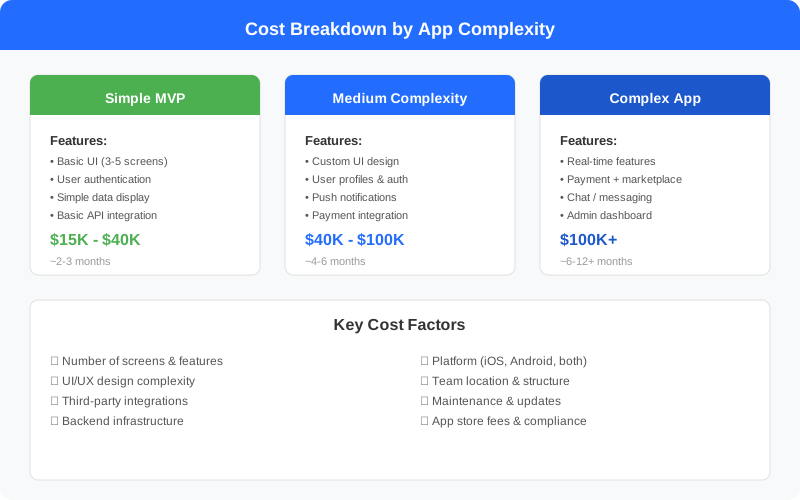
Simple app (MVP)
Range: $15,000 – $40,000
A simple app has basic functionality, a clean UI with 3–5 screens, and minimal backend requirements. Think of a straightforward tool: a calculator, a note-taking app, a basic directory, or a simple content reader.
What you get:
- Basic user interface
- User authentication (email, Google, or Apple sign-in)
- Simple data display and interaction
- One backend integration (API or Firebase)
- Published on one platform (iOS or Android) or both via cross-platform
Timeline: 6–10 weeks
Medium-complexity app
Range: $40,000 – $100,000
A medium app has custom UI design, user profiles, push notifications, and at least one significant integration (payments, maps, or social login). This is where most business apps land.
What you get:
- Custom visual design reflecting your brand
- User accounts with profiles and settings
- Push notifications
- Payment or e-commerce integration
- Multiple API integrations
- Both iOS and Android (via cross-platform framework)
- Basic admin panel
Timeline: 3–5 months
Complex app
Range: $100,000 – $500,000+
Complex apps have real-time features (chat, live updates), marketplace functionality, advanced search, content management, and sophisticated backend logic. Think ride-sharing, food delivery, social platforms, or fintech apps.
What you get:
- Real-time data synchronization
- Chat or messaging system
- Payment processing with escrow or split payments
- Admin dashboard with analytics
- Multi-role user system (user, vendor, admin)
- Scalable cloud infrastructure
- Advanced security and compliance
Timeline: 6–12+ months
What drives the cost up
Understanding the cost factors helps you make trade-off decisions that save money without sacrificing quality.
Number of platforms
Building for both iOS and Android from scratch doubles your development cost. Cross-platform frameworks (React Native, Flutter) reduce this to roughly 1.3–1.5x the cost of a single platform — a major saving.
UI/UX design complexity
A simple, clean interface costs far less than a highly custom, animation-rich design. If your app needs custom illustrations, micro-animations, or complex navigation patterns, expect the design phase to take longer and cost more.
Backend and infrastructure
Apps that handle user data, payments, or real-time communication need a server-side backend. The complexity of this backend — the number of API endpoints, database design, and third-party integrations — significantly impacts cost.
Third-party integrations
Each integration adds development time and ongoing maintenance:
| Integration | Approximate added cost |
|---|---|
| Authentication (Google, Apple, email) | $1,000 – $3,000 |
| Payment processing (Stripe, in-app) | $2,000 – $5,000 |
| Push notifications | $1,000 – $2,500 |
| Maps and location | $1,500 – $4,000 |
| Social media integration | $1,000 – $3,000 |
| Chat / messaging | $5,000 – $15,000 |
| Analytics and reporting | $1,000 – $3,000 |
Team structure and location
Where your development team is based significantly affects cost:
| Team type | Typical hourly rate | Pros | Cons |
|---|---|---|---|
| Freelancer (offshore) | $15 – $40/hr | Lowest cost | Variable quality, harder to manage |
| Offshore agency | $25 – $60/hr | Good balance | Time zone challenges |
| Nearshore agency | $40 – $80/hr | Overlapping hours | Moderate cost |
| Local agency | $80 – $175/hr | Close collaboration | Highest cost |
| In-house team | $100K – $250K/year each | Full control | Expensive, slow to assemble |
For most businesses, a mid-sized agency with cross-platform expertise offers the best balance of cost, quality, and speed.
The costs most people forget
The app itself is not the only expense. Budget for these often-overlooked costs:
App store fees
- Apple Developer Program: $99/year
- Google Play Developer: $25 one-time
- Apple takes 15–30% of in-app purchases and subscriptions
Ongoing maintenance
Apps need regular updates — bug fixes, OS compatibility updates, security patches, and feature improvements. Plan for 15–20% of the initial build cost per year for maintenance.
For a $50,000 app, that is $7,500 – $10,000 per year.
Server and infrastructure costs
Backend hosting (AWS, Google Cloud, Firebase) costs money based on usage. For a small-to-medium app, expect $50 – $500/month. As your user base grows, so do these costs.
Design updates
Your app’s design will need refreshing as trends change and your brand evolves. This is a separate budget line from the initial design.
Marketing and user acquisition
Building the app is half the equation. Getting people to download it is the other half. Budget for app store optimization, social media marketing, and potentially paid advertising.
How to reduce costs without cutting corners
Start with an MVP
Build the smallest version that solves the core problem. Skip nice-to-have features for version 1.0 — you can always add them later based on what real users actually need.
Use cross-platform development
React Native or Flutter gives you both platforms at roughly 30–50% less cost than building two separate native apps.
Reuse existing solutions
Do not build authentication, payments, or analytics from scratch. Use established services (Firebase, Stripe, Auth0) that handle the complexity for you.
Focus on one platform first
If budget is tight, launch on Android first (larger global market) or iOS first (higher revenue per user) depending on your strategy, then expand.
Design once, develop once
Invest in thorough wireframing and prototyping before development starts. Changes made during development are 5–10x more expensive than changes made during design.
A real-world example
A typical business app — an ordering platform for a restaurant chain with custom branding, menu management, order tracking, push notifications, and payment integration — would fall in the medium-complexity tier:
| Component | Estimated cost |
|---|---|
| UI/UX design (custom) | $5,000 – $10,000 |
| Frontend development (cross-platform) | $15,000 – $25,000 |
| Backend development | $10,000 – $20,000 |
| Integrations (payment, notifications, analytics) | $5,000 – $10,000 |
| Testing and QA | $3,000 – $7,000 |
| Total | $38,000 – $72,000 |
This app would take approximately 3–5 months to build and launch.
The bottom line
App development is an investment, not an expense. A well-built app can generate significant revenue, streamline operations, and strengthen your brand. But going in with unrealistic cost expectations leads to cutting corners, launching late, or abandoning the project entirely.
The smartest approach: start with a focused MVP, launch quickly, learn from real users, and invest in improvements based on data. This minimizes your risk and maximizes your return.
At DNS Progress, we help businesses plan and build mobile apps within realistic budgets. We will tell you honestly what your idea requires — no inflated estimates, no surprise costs. If you want to understand what your app would cost, talk to us — the first conversation is free.
Related articles
How to Build a Mobile App from Scratch in 2026
A complete step-by-step guide to building a mobile app — from idea to app store launch. Covers planning, design, development, testing, and deployment.
Read article →
PWA vs Native App in 2026: Which One Does Your Business Need?
Should you build a Progressive Web App or a native mobile app? A practical guide comparing cost, performance, features, and use cases to help you decide.
Read article →
React Native vs Flutter in 2026: Which One Should You Choose?
A practical comparison of React Native and Flutter in 2026 — performance, developer experience, ecosystem, and real-world trade-offs to help you pick the right framework.
Read article →Need help building your product?
We build mobile apps, websites, and custom software for businesses. Tell us about your project and get honest advice — free.