

React Native vs Flutter in 2026: Which One Should You Choose?
September 2026 · DNS Progress Team
Choosing a mobile framework is one of the first decisions that shapes your product — and your team — for years. React Native and Flutter are the two dominant cross-platform options in 2026, and both are excellent. But they are excellent in different ways. This guide breaks down the real differences so you can pick the framework that fits your project, your team, and your timeline.
The core difference: how they render
Understanding how each framework draws pixels on screen is the single most important thing for making an informed choice.
React Native uses JavaScript to communicate with the platform’s native
UI components. When you write a <Button> in React Native, it renders a
real UIButton on iOS or android.widget.Button on Android. The result
looks and feels native because it is native — your code is a bridge
between JavaScript logic and platform widgets.
Flutter takes a different approach. It ships its own rendering engine
(based on Skia/Impeller) and draws every pixel from scratch. When you write
a ElevatedButton in Flutter, it is not using the platform’s native button
— Flutter paints it directly onto a canvas. This gives Flutter total control
over what appears on screen.
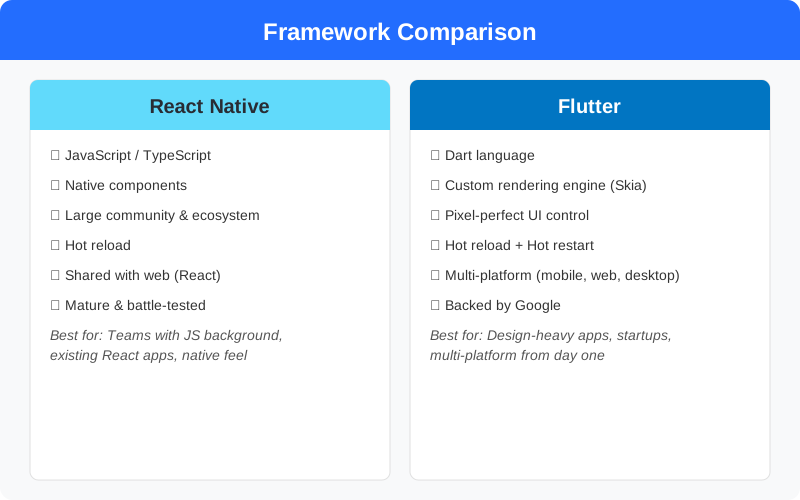
Language and learning curve
| Aspect | React Native | Flutter |
|---|---|---|
| Language | JavaScript or TypeScript | Dart |
| Learning curve | Low if you know React/JS | Moderate — Dart is new for most teams |
| Typed safety | Optional (TS adds it) | Built-in, strong typing |
| Community resources | Massive — same ecosystem as React | Growing fast, backed by Google |
If your team already writes React for the web, React Native feels immediately familiar. You reuse the same mental model — components, hooks, state management — and the JavaScript ecosystem gives you access to thousands of libraries.
Flutter requires learning Dart, which most developers have not used before. The learning curve is not steep — Dart is approachable — but it is a new language, a new package manager, and a new way of thinking about UI. On the flip side, once your team learns Dart, they get a single language for mobile, web, and desktop with Flutter.
Performance
Both frameworks deliver excellent performance for the vast majority of app use cases. The differences show up at the margins.
Startup time
Flutter apps tend to have slightly faster cold-start times because Flutter controls the entire rendering pipeline — there is no JavaScript bridge to initialize. React Native’s bridge (or the new Fabric architecture) adds a small overhead, though recent improvements have narrowed the gap significantly.
UI rendering
For most UI patterns — lists, forms, navigation, animations — both frameworks perform identically from the user’s perspective. The differences appear in complex, custom animations or high-frequency UI updates (60fps+ game-like interfaces), where Flutter’s direct canvas access gives it a slight edge.
Heavy computation
Neither framework is designed for heavy computation on the UI thread. Both support native modules for offloading work to platform-specific code. In practice, your bottleneck will be your architecture (how you structure background work), not the framework itself.
For 90% of business applications, performance is not the deciding factor between React Native and Flutter. Choose based on your team and ecosystem needs instead.
Ecosystem and libraries
This is where React Native has a clear advantage in 2026.
React Native inherits the entire npm ecosystem. Libraries for state management (Redux, Zustand, Jotai), navigation (React Navigation), forms (Formik, React Hook Form), and every other need have mature, battle-tested implementations. If a JavaScript library exists for it, you can likely use it in React Native.
Flutter’s pub.dev ecosystem has grown impressively. Packages for firebase, authentication, payments, camera, and maps are all mature. But the total number of packages is still smaller than npm, and some niche use cases may require writing custom native code.
The bridge to native code
Both frameworks let you write native modules when you need platform-specific functionality (Bluetooth, NFC, custom hardware). React Native uses “native modules” (Objective-C/Swift for iOS, Kotlin/Java for Android). Flutter uses “platform channels” with the same languages. Both approaches work well, but React Native’s larger community means more pre-built native integrations exist.
Development experience
Hot reload
Both frameworks offer hot reload — see your changes instantly without recompiling. This is a massive productivity boost compared to traditional native development.
Flutter’s hot reload is often cited as slightly more reliable because Flutter controls the full rendering stack. React Native’s fast refresh has improved dramatically with the new architecture but can occasionally require a restart when native modules are involved.
Tooling
Flutter ships with excellent first-party tooling: flutter create,
flutter test, flutter build, built-in widget inspector, and devtools
for performance profiling. The out-of-the-box experience is polished.
React Native relies on the broader React ecosystem for tooling — Expo has become the de facto standard for project setup and development, offering a managed workflow that handles builds, testing, and deployment.
Debugging
Both offer solid debugging tools. Flutter’s DevTools suite is integrated and comprehensive. React Native benefits from the Chrome/Firefox DevTools ecosystem that JavaScript developers already know.
When to choose React Native
React Native is the better choice when:
- Your team already knows React and JavaScript/TypeScript.
- You are building a companion app for an existing React web application.
- You need access to a specific native library that has a React Native wrapper but no Flutter package.
- You want to share code between your web and mobile applications.
- You prefer a framework with the largest community and most Stack Overflow answers.
When to choose Flutter
Flutter is the better choice when:
- You need pixel-perfect UI that must look identical on every device.
- You are building an app where custom animations and visual polish are critical to the product.
- You want to target mobile, web, and desktop from a single codebase with minimal compromise.
- Your team is starting fresh and has no existing JavaScript/React investment.
- You value a tightly integrated, first-party development experience with fewer third-party dependencies.
What about the new architecture?
React Native’s new architecture (Fabric, TurboModules, and the JSI) has been stable since 2025 and brings significant improvements: faster communication between JavaScript and native code, better concurrency, and elimination of the old async bridge. This closes many of the historical performance gaps with Flutter.
Flutter, meanwhile, has shipped Impeller — a new rendering engine that replaces Skia for 2D graphics. Impeller improves shader compilation performance, reducing the occasional stuttering that Flutter apps experienced on first launch.
Both frameworks are actively innovating, and the gap between them continues to narrow.
The honest answer: both are good
There is no objectively “better” framework. The right choice depends on your specific situation:
| Factor | Lean React Native | Lean Flutter |
|---|---|---|
| Team background | React / JavaScript | No existing framework investment |
| UI requirements | Standard business UI | Custom, pixel-perfect designs |
| Platform targets | Mobile primarily | Mobile + web + desktop |
| Ecosystem needs | Wide library access | Tight integration, fewer deps |
| Code sharing | Shared with React web | Shared across all platforms |
The worst mistake is over-analyzing the framework choice. Both React Native and Flutter can build excellent products. The quality of your product depends far more on your team, your process, and your understanding of the problem you are solving than on which framework you picked.
If you are unsure which direction to take, start with a small prototype in both frameworks. A week of hands-on experimentation will teach you more than a hundred comparison articles — including this one.
At DNS Progress, we have built products with both frameworks and help clients choose based on their specific needs, not trends. If you are planning a mobile app and want an honest assessment of which technology fits your project, talk to us — the first conversation is free.
Related articles
From Idea to Launch: How We Build Digital Products
A behind-the-scenes look at how the DNS Progress team takes a product from a rough idea to a launch on Google Play — with a process built for speed and quality.
Read article →
How to Build a Mobile App from Scratch in 2026
A complete step-by-step guide to building a mobile app — from idea to app store launch. Covers planning, design, development, testing, and deployment.
Read article →
Mobile App Development Cost in 2026: A Complete Breakdown
How much does it cost to build a mobile app in 2026? A detailed breakdown by complexity, platform, team type, and hidden costs most people forget.
Read article →Need help building your product?
We build mobile apps, websites, and custom software for businesses. Tell us about your project and get honest advice — free.